
Standardization Is Not Fairness
How institutions confuse treating everyone the same with giving everyone an equal chance to succeed.

Most institutions believe fairness means consistency.
The same rules. The same process. The same expectations applied to everyone, without exception.
On paper, that sounds fair.
In practice, it often isn’t. Standardization and fairness are not the same thing. But the deeper problem is not that standardized processes create barriers. The deeper problem is what those processes do before anyone even encounters a barrier.
They define what competence looks like.
And once an institution has defined competence, it has also quietly defined who appears competent and who doesn’t.
Preferences dressed as standards
When an institution designs a process, it makes choices. Which format. Which timeline. Which inputs count. Which behaviors get rewarded. How communication should sound. How learning should look. How performance should be demonstrated.
Every one of those choices encodes a preference. A preference for one cognitive style over others. For one communication register over others. For one way of processing information, managing time, tolerating sensory environments, and signaling capability.
That preference does not stay a preference for long.
Once it is built into a process, it becomes a requirement. Once it is a requirement, it becomes a standard. Once it is a standard, it becomes the definition of normal. And once something is normal, questioning it stops feeling like institutional critique and starts feeling like a personal failure to meet a reasonable expectation.
This is how preferences become standards, and standards become invisible.
The institution does not experience its process as a set of choices. It experiences it as a neutral framework. The people who perform well inside it appear talented. The people who struggle inside it appear deficient. But the field was never level. It was designed by people, for a particular kind of person, and then called objective.
Institutions do not discover normal. They define it.
This is the most consequential thing institutions produce: not policy, not procedure, but normality itself.
They decide what communication looks like. What professionalism looks like. What intelligence looks like. What competence looks like. And the resulting standard is routinely mistaken for an objective description of reality rather than a design choice made by people operating within a particular culture and cognitive framework.
Neurodivergent people often make these assumptions visible, not because they are more affected than all other groups, but because they are among those most likely to diverge from the institutional prototype in ways the institution did not anticipate and did not design for. When the prototype assumes one way of processing language, managing attention, tolerating sensory input, reading social cues, and demonstrating knowledge, neurodivergent people encounter not just a difficult process but a process that was not built with their existence in mind.
That gap between the person and the prototype is regularly interpreted as a gap in the person. The design remains unexamined.
The chain runs in one direction: preference becomes standard, standard becomes normal, normal becomes the definition of competence. By the end of that chain, the original preference is invisible. It has become reality. And anyone who does not conform to it has become, in the institution’s accounting, deficient.
The legitimacy problem
A standardized process does more than evaluate performance.
It defines what performance looks like.
A job interview does not simply identify qualified candidates. It defines which communication styles appear professional. A classroom does not simply measure learning. It defines what learning should look like. A performance review does not simply assess contribution. It defines which behaviors count as contribution.
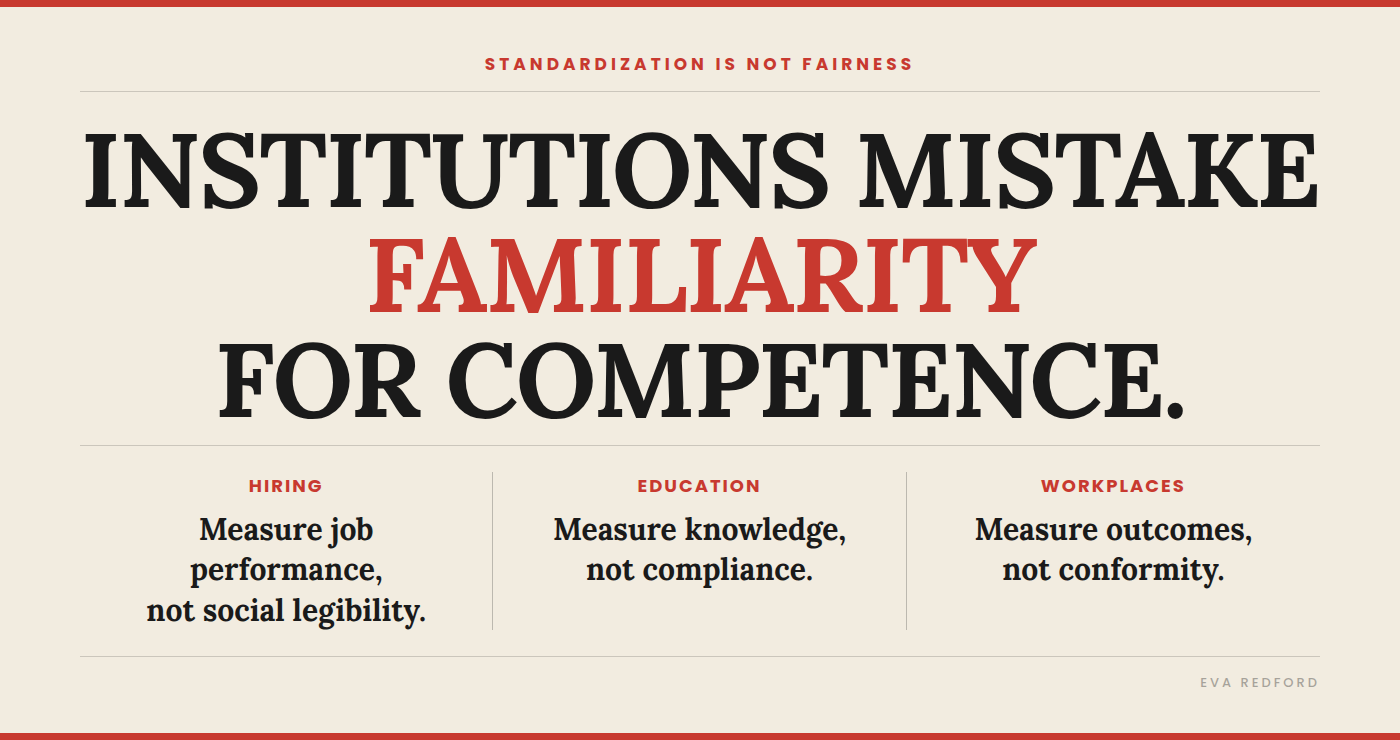
Once those definitions are institutionalized, the people who naturally fit them appear competent. Those who do not fit them appear deficient. The institution mistakes familiarity for merit.
The result is a self-reinforcing legitimacy system. The people who fit the standard succeed. Their success validates the standard. The standard becomes harder to question. Those who are excluded are treated as exceptions, as individual shortcomings, rather than as evidence of a design problem.
That is why standardization is so powerful. It does not just distribute opportunities. It distributes legitimacy. And legitimacy, once distributed, shapes how people are seen, not just professionally, but fundamentally. As capable or incapable. As credible or not credible. As qualified or not qualified.
The institution calls this a meritocracy. What it has actually built is a system that rewards people who match its prototype, and then uses their success as proof that the prototype was right.
Legibility and credibility
The legitimacy problem does not stop at access. It extends to whose account gets believed.
Once institutions define what competence looks like, they also, as a consequence, define what credibility looks like.
The employee who communicates in familiar ways is seen as professional. The student who learns in familiar ways is seen as intelligent. The candidate who interviews in familiar ways is seen as capable. These legibility assessments quietly shape something beyond evaluation. They shape how much weight an institution gives to what a person says.
When someone falls outside those expectations, their account becomes easier to dismiss. Their requests are questioned. Their performance is scrutinized more closely. Their explanations are treated as excuses. The same traits that reduce institutional legibility tend to reduce institutional credibility, not because the person is less reliable, but because they present differently than the prototype the institution learned to trust.
This produces a specific and damaging loop. The people most affected by a design problem are frequently the least believed when they identify it. An employee who diverges from the communication prototype raises a concern about the performance review criteria. The concern is heard through the same evaluative lens that produced the problem. The employee appears difficult, defensive, lacking self-awareness. The design remains unexamined.
This is not a failure of individual judgment. It is a structural feature of systems that have mistaken their own prototype for an objective standard. Once a standard is treated as neutral, challenges to it can only appear as the challenger’s problem.
Hiring: the social legibility test
The job interview is the most visible site of this pattern.
Most organizations require every candidate to complete the same process. Same questions. Same format. Same unspoken expectations about eye contact, verbal fluency, affect, social timing, and the performance of confidence in an unfamiliar room with strangers evaluating every word.
The process is standardized. It is also, quietly, a test of social legibility: the ability to present oneself in ways that read as professional, capable, and trustworthy to a particular kind of evaluator.
The problem is not that social legibility is being assessed. The problem is that it is being assessed instead of job performance, while being labeled as an evaluation of job performance.
“Culture fit” makes this most explicit. It functions as a hiring criterion while treating the existing culture as neutral, as if the dominant communication style, the expected social register, the informal norms about self-presentation are simply how things are, rather than a set of preferences that certain people learned to embody and others didn’t.
When a candidate is screened out for culture fit, the institution has not assessed whether they could do the job. It has assessed whether they resemble the people already there. Those are different measurements. Treating them as equivalent is not a neutral choice. It is a design decision that favors conformity to an existing prototype and calls that conformity competence.
Workplaces: the institutionalization of one cognitive style
The same pattern extends into employment itself.
Many workplaces have communication norms that are treated as professional standards while functioning, in practice, as one cognitive style elevated into a universal requirement.
Direct communication gets interpreted as rudeness. A flat affect gets read as disengagement. A preference for written over verbal communication gets framed as inflexibility. Small talk gets treated as a relationship-building competency. The ability to process verbal instructions in real time, without written reference materials, is treated as a basic professional expectation rather than one particular way of receiving information.
None of these norms are neutral. They reflect the preferences of the people who had the most power to define what professionalism means. Because those people experienced the norms as natural, the norms became invisible as preferences. They became the baseline. The definition of what a capable professional looks like.
Performance reviews make this concrete. Criteria like “executive presence,” “stakeholder management,” “communication style,” and “tone concerns” frequently measure conformity to social expectations rather than outcomes. An employee can produce excellent work and receive critical feedback because the way they delivered that work did not match the expected register.
This is not performance assessment. It is a legibility test, one that measures how closely a person’s natural style matches the institutional prototype. When that test produces a gap, the gap is attributed to the person. The prototype remains unexamined.
Education: measuring compliance, crediting it as intelligence
Schools offer perhaps the most consequential version of this problem, because the judgments produced there follow people for the rest of their lives.
The standardized test is presented as an objective measure of ability. It also measures processing speed, test-taking strategy, stress tolerance, and the capacity to perform under artificial time pressure. These are not the same thing as knowledge or intelligence. But because the test is uniform, because everyone takes the same one, its results are treated as if they measure something intrinsic to the student rather than something produced by the interaction between the student and the test design.
The same logic runs through grading systems, participation requirements, and the general expectation that learning should look a specific way: seated, quiet, regulated, compliant, making eye contact with the speaker, raising a hand before speaking. These are not descriptions of learning. They are descriptions of one particular performance of learning, the performance that was legible to the people who designed the system.
When a student cannot produce that performance, the system codes them as a problem. Unmotivated. Inattentive. Behind. The language of deficit is applied to the student rather than to the design that produced the assessment.
The longer-term effect is not just an unfair grade. It is an institutional judgment about intelligence and potential, a judgment that gets recorded, reported, and carried forward into every subsequent institution that student encounters. Standardized processes in education do not just measure. They produce the categories of capable and deficient. And they produce those categories using instruments built around one cognitive prototype, presented as universal truth.
The better question
Institutions often believe they are measuring competence.
In reality, many are measuring resemblance. Resemblance to the people who designed the process. Resemblance to the people who already succeeded within it. Resemblance to a prototype that became a standard and a standard that became “normal.”
Real fairness requires a different diagnostic question. Not: “Did everyone receive the same process?” But: “Did the process accurately measure what it claims to measure, for everyone it was applied to?”
Those are not the same question. The first defends the process by pointing to its consistency. The second interrogates whether the process was valid in the first place.
Consistency is not validity. A process applied equally to everyone still cannot measure competence if it was designed to measure conformity to a specific cognitive prototype and then labeled as something else. Institutions that take the second question seriously are forced to examine the assumptions inside their own designs. What does this process actually require? Who does it systematically favor? Is what it rewards genuinely related to the outcomes it claims to predict? Or has familiarity been mistaken for merit?
Those questions are uncomfortable. They implicate the people who built and currently benefit from the system. They suggest that success inside the institution is not purely a function of capability. It is also, in part, a function of how closely a person’s natural style matches the prototype the institution decided to reward.
The question is not whether everyone was treated the same.
The question is whether the institution ever recognized the difference between competence and conformity.
The most powerful forms of exclusion do not announce themselves as exclusion.
They present themselves as standards.
They call conformity competence.
They call familiarity merit.
And they keep distributing legitimacy to the people who were always going to fit, while describing the outcome as fair.
© 2026 Eva Redford